Slow Pours and High Altitude: The Alpine Wine Villages Quietly Stealing American Travelers From Napa
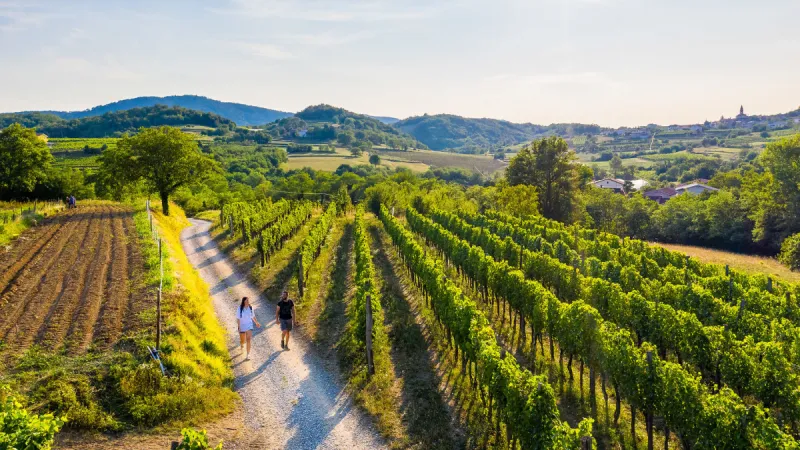
Photo: Alpine vineyard village Austria Slovenia mountain wine terrace hiking, via www.slovenia.info
There's a particular kind of exhaustion that sets in around Napa Valley on a Saturday in July. The shuttle buses. The reservation confirmations. The tasting flights that cost more than a roundtrip bus ticket and last exactly forty-five minutes before a staff member gently herds you back toward the gift shop. You came for wine. You got a transaction.
Now imagine waking up in a village of 400 people somewhere in the Styrian hills of southern Austria. The air smells like cut grass and something fermenting nearby, because something always is. A winemaker you met at dinner last night has invited you to walk the vines before the heat comes up. Later, there's a trail that climbs through beech forest to a ridge with views that make your phone feel inadequate. By evening, you're back in the village, sitting at a wooden table outside a Buschenschank — the Austrian version of a farm wine tavern — drinking an orange wine that doesn't exist outside this valley and eating cold cuts made from a pig that had a better life than most Americans.
This is what's pulling a certain kind of American traveler away from the marquee wine regions. Not luxury. Not exclusivity in the velvet-rope sense. Just the opposite: radical accessibility, radical slowness, and wine that actually has something to say.
Why the Alps, and Why Now
The short answer is overcrowding. The longer answer involves a generational shift in what American travelers in their late twenties and thirties actually want from a wine trip. Survey data from travel platforms consistently shows that younger US travelers prioritize authenticity and outdoor activity over curated luxury experiences. The Alps happen to offer both in abundance, and the wine — particularly from regions that have only recently appeared on American radar — gives them a reason to stop moving.
Austria's Steiermark (Styria), Slovenia's Vipava Valley, and the Swiss canton of Valais each represent a different flavor of this phenomenon. What they share is a combination of serious viticulture, genuine village life, and hiking infrastructure that would make any trail runner weep with gratitude. What they lack is the Instagram-industrial complex that has turned so many American wine regions into content farms.
Styria: Austria's Best-Kept Wine Secret
Southern Styria sits just above the Slovenian border, a landscape of rolling hills covered in Sauvignon Blanc and Welschriesling vines that look almost too cinematic to be real. The village of Gamlitz is a reasonable base — small enough to walk end to end in twenty minutes, connected enough to reach Graz in under an hour if you need a city fix.
The Buschenschank culture here is the thing Americans never fully anticipate. These are farm taverns, legally permitted to sell only what the property produces: wine, cold food, maybe schnapps. No kitchens, no menus in the conventional sense. You show up, you sit down, a wooden board appears with local cheese and cured meats, and someone pours you whatever's open. The bill, when it comes, is always lower than you expected.
Jason Mercer, a former sommelier from Portland who relocated to a village outside Leibnitz six years ago, puts it plainly: "In the US, wine culture is aspirational. Here it's just Tuesday. The guy pouring your glass probably pruned those vines in February. That changes how the wine tastes, or at least how you receive it."
Mercer now runs informal wine hike experiences for small groups, combining morning trail walks through the vineyard corridors with afternoon tastings at family producers who rarely see foreign visitors. His waiting list, he says, has gotten longer every year since 2022.
Slovenia's Vipava Valley: The Overachiever Nobody's Talking About
If Styria is the quiet achiever, Slovenia's Vipava Valley is the overachiever that somehow still flies under the radar. Located about an hour east of Trieste (making it genuinely easy to reach from a major European hub), the valley produces wines from indigenous varieties — Zelen, Pinela, Klarnica — that you genuinely cannot find anywhere else on earth.
The village of Vipava itself is worth a slow afternoon. The main square has a bar or two, a fountain, and the kind of unhurried afternoon energy that makes you recalculate how you've been spending your weekends. The Nanos plateau above the valley offers hiking with views across to the Adriatic on clear days. The combination of altitude, karst terrain, and the bora wind that periodically rips through the valley gives the wines here a tension and minerality that wine people find genuinely exciting.
Amanda Kowalczyk, a travel writer from Chicago who spent three weeks in the valley last autumn, describes the experience as "the first time I've been on a wine trip where I actually forgot to post about the wine." She ended up extending her stay twice, working remotely from a rented room above a family winery and hiking every morning before her laptop opened.
"There are no tour buses," she says. "There are no tour buses and there is very good wine and the trails are empty by 9am. It's almost unfair."
Valais, Switzerland: Expensive Country, Surprisingly Approachable Wine Culture
Swiss wine has a reputation problem in America, mostly because almost none of it gets exported. The country drinks what it makes, which means the only way to properly explore Valais — the steep, sun-baked valley that produces the bulk of Swiss wine — is to actually go there.
The expense of Switzerland is real and worth acknowledging. But the wine culture in villages like Chamoson, Leytron, and Saillon operates on a different register than Swiss cities. Producers here are small-scale, often multigenerational, and accustomed to visitors who arrive on foot from the trails above. The Chemin du Vignoble, a marked hiking route that winds through the vineyards between Martigny and Sierre, is one of the more underrated wine-trail experiences in Europe — a genuine working landscape you walk through rather than observe from a bus window.
The indigenous Chasselas grape, often dismissed elsewhere as neutral and uninteresting, finds its most compelling expression in Valais, where the altitude and dry continental climate push it toward something genuinely worth seeking out. Pair it with a raclette situation at a village restaurant and reconsider everything you thought you knew.
What This Means for How You Plan Your Trip
The practical reality of an Alpine wine village trip is that it requires a different planning mindset than a Sonoma weekend. Trains are your friend — Austria and Switzerland have rail infrastructure that makes a car feel redundant. Slovenia requires a bit more flexibility, but the country is small enough that renting a car in Ljubljana and driving to the Vipava Valley takes under an hour.
Accommodation is almost universally small-scale: guesthouses above wineries, village B&Bs, the occasional agriturismo equivalent. Booking platforms like Booking.com cover the basics, but direct outreach to wineries — especially in Slovenia and Styria — often turns up room options that don't appear online at all.
The other thing worth knowing: these regions reward staying put. The temptation to village-hop is real, but the travelers who report the best experiences are the ones who picked one place and gave it a week. You start recognizing faces. The winemaker remembers what you liked yesterday and opens something different. The trail you didn't finish on Tuesday is still there on Friday.
That's the thing about Alpine wine villages that no amount of Napa marketing budget can replicate. They're not trying to impress you. They're just going about their lives, and they've left the door open if you want to come in.
Pull up a chair. There's wine on the table and a trail map on the wall. No reservations required.